
How businesses can get enhanced digital exposure through F.A.C.T.S model.
For a very long time digital visibility of a brand or business was predominantly associated with Google. The ultimate goals were: get a high ranking on google search and boost reviews on google in order to enhance visibility.
But there has been a major shift over the past few years and visibility and engagements have been emphasized on various other platforms such as Instagram, Meta, Youtube as well as AI platforms including ChatGPT, Gemini, etc.
The way in which individuals search has also changed over time. People have become more detail focused and more aware when they search about a particular topic. For example: Instead of searching for ‘best doctors near me’ on Google, people may search ‘best doctors near me for liver issues, who also have excellent reviews and are available on weekends.’ on ChatGPT.
This enquiry/search from the person is very complicated in nature and having a website is not enough in such cases. Its information needs to be current, credible, consistent, trustworthy, and relevant to the question being asked.
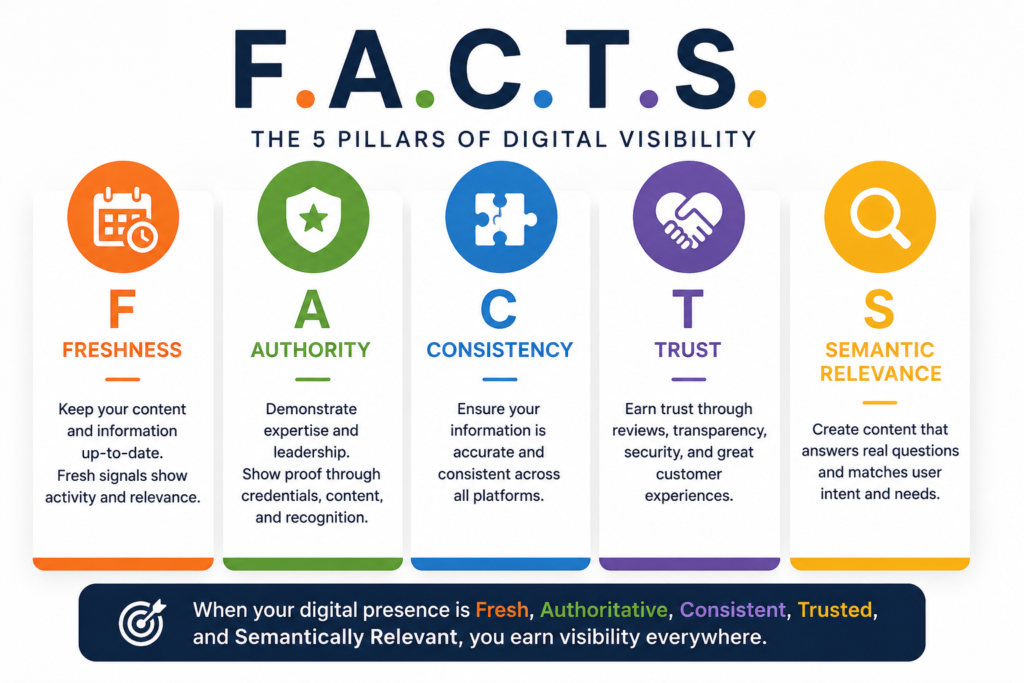
FACTS framework is helpful in such cases. Let’s look at what this framework represents and how it can tackle this problem. F- freshness, A- authority, C-consistency T-trust and S- semantic relevance.
How businesses can get enhanced digital exposure through the F.A.C.T.S model.
For a very long time digital visibility of a brand or business was predominantly associated with Google. The ultimate goals were: get a high ranking on google search and boost reviews on google in order to enhance visibility.
But there has been a major shift over the past few years and visibility and engagements have been emphasized on various other platforms such as Instagram, Meta, Youtube as well as AI platforms including ChatGPT, Gemini, etc.
The way in which individuals search has also changed over time. People have become more detail focused and more aware when they search about a particular topic. For example: Instead of searching for ‘best doctors near me’ on Google, people may search ‘best doctors near me for liver issues, who also have excellent reviews and are available on weekends.’ on ChatGPT.
This enquiry/search from the person is very complicated in nature and having a website is not enough in such cases. Its information needs to be current, credible, consistent, trustworthy, and relevant to the question being asked.
FACTS framework is helpful in such cases. Let’s look at what this framework represents and how it can tackle this problem. F- freshness, A- authority, C-consistency T-trust and S- semantic relevance.
- Freshness
Ever find a restaurant you’re dying to try, only to be totally confused by their hours? Their website says they open at 10 AM, but Google Maps mentions a different time and and their Instagram bio claims a different time. In that moment of frustration you might cancel your plans of dining from that restaurant.Maintaining freshness means ensuring your overall digital footprint remains entirely up to date.
This concept encompasses far more than just standard blog updates.
To keep the trust of both humans and AI, you need to refresh your details across every touchpoint:
- Company website
- Google Business Profile
- Google Maps listings
- Social media profiles
- Online review portals
- Local directories
- Service-specific sections
- Product listings
- FAQs
Think about it: when you change your timings for a holiday, add a new service to your business or move to a new office, you have to be consistent. If you miss even one platform, customers might feel confused with your info that kills their trust. Plus, today’s search engines and AI tools get totally tripped up by old, fuzzy data, which means your business might not even show up when it should.
Strategies for enhancing freshness
Maintaining a strong digital image does not necessarily require you to develop a sophisticated strategy. Just follow these simple steps in order to stay up-to-date:
Opening and Closing Times: Double-check whether the information about your operating hours is correct.
Contact Information: Check if the phone number and email are up-to-date.
Services and Prices: Inform customers about any changes in your services and prices.
Location and Photos: Make sure your location information is correct and your images are uploaded correctly.
Active Promotions and Frequently Asked Questions: Update all that is currently active on your page.
Temporary Holiday Hours/Information: Make sure to include this information.
Being up-to-date means not posting any unnecessary content in order to appear more active, but rather being able to provide the most relevant and updated information when it comes to the customer’s needs.
2. Authority: Giving People Reasons to Believe in You
It is quite simple for anyone to create a website and claim that they are an expert in some field or another. True authority is built upon showing proof.
Imagine a person seeking the services of a financial advisor and visiting two company websites.
The first one only claims: “We are the best financial advisors in town.” The second company provides all sorts of information regarding their credentials, experience, certifications, areas of expertise, press features, publications, and clients’ achievements.
Which option sounds more believable?
Obviously, the second one does. True authority is based on providing proof, not on praising yourself. Some of the effective indicators of authority in your particular field can be:
- Academic and professional credentials
- Certifications
- Awards and recognition
- Years of practice
- Research publications and whitepapers
- Media involvement
- Press features
- Keynotes
- Case studies
- Insights
- Data
- Strategic partnerships
- Affiliations
- High-quality educational content
Your platform should provide detailed information about the people running the business and about the qualifications that make them credible and reliable.
3. Consistency: Ensure Each Platform Tells the Same Story
There is no doubt that your business is present on many different digital platforms.
Your website portrays one image.
Google portrays another.
Facebook uses an outdated phone number.
A directory displays your former address.
Instagram uses yet another description of your services.
This can be very confusing.
Consistency means that the critical information about your business should be the same across the platforms where customers and search engines are likely to find you.
In the case of a local business, this includes:
- Business Name
- Address
- Phone Number
- Website
- Hours of Operation
- Services Provided
- Categories
- Locations
- Brand Description
However, consistency is not limited to basic contact information.
Your brand positioning should also be consistent across different platforms.
Imagine that your website describes your company as a high-end interior design studio, while your social media describes you as a cheap contractor.
4. Trust: What Are Other People Saying About You?
You can tell your clients that you are great.
However, they will also want to know: “What do other people say?”
For many consumers, online reviews are assessed before contacting a company or placing an order.
There are many ways in which customers get an impression of a brand or service:
A. Customer Trust
- Testimonials
- Ratings
- Customer-generated content
- Case studies
- Before and after
B. Professional Trust
- Certifications
- Awards
- Industry affiliations
- Expert recommendations
- Media recognition
- Partnerships
There is one particular aspect worth emphasizing here.
A high number of reviews does not mean high trust.
It is possible that a company with thousands of reviews gets the same complaint over and over again and still does not look trustworthy.
In fact, businesses need to listen to what customers repeat.
If there are constant complaints about wait time, communication, delivery, or poor quality of service, the solution is not to get more reviews.
The experience must be changed.
Reputation is essentially operational.
Marketing may attract people to a company.
But trust can only be earned through experience.
5. Semantic Relevance: Answer the Question Behind the Search
It is probably the most important transformation for organizations trying to adopt AI-powered search technology.
Traditional SEO paid significant attention to keywords.
But people do not always use the exact words from the website when conducting their searches.
Imagine that someone needs a fitness center.
They may type the following into the search bar:
“Gym near me”
But their true desire would be to find one that is:
- Open in the morning before work
- Suitable for beginners
- Offers personal training
- Has female trainers
- Offers boxing
- Has affordable monthly membership
- Is not too crowded at night
A keyword is just an expression of the question posed by the user.
Semantic relevance requires finding out what the real need is behind the search.
The website must, therefore, provide answers to the questions your customers are asking.
For example, a fitness company can produce content related to:
- Membership options
- Personal training
- Programs for beginners
- Training times
- Equipment
- Boxing courses
- Diet tips
- FAQs
- Parking
- Cancellation policies
- High-traffic hours